
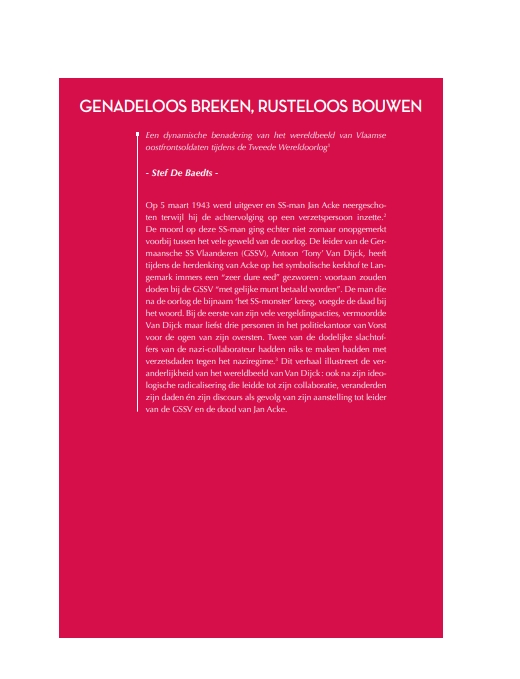
Genadeloos breken, rusteloos bouwen. Een dynamische benadering van het wereldbeeld van Vlaamse oostfrontsoldaten tijdens de Tweede Wereldoorlog
Merciless breaking, restless building : A dynamic approach to the worldview of Flemish Eastern Front soldiers during the Second World War;
Briser sans pitié, construire sans relâche. Une approche dynamique de la vision du monde des soldats flamands du front de l’Est pendant la Seconde Guerre mondial
Discipline
Humanities
History and Archaeology
Subject
second world war
military collaboration (WWII)
Audience
Scientific
Date
2025-03-01Publisher
CegeSoma (State Archives of Belgium)
State Archives of Belgium
Metadata
Show full item recordDescription
This article is published as part of Journal of Belgian History, LV(1), 2025. (NL) In dit artikel worden de ideologie en het wereldbeeld van Vlaamse collaborateurs tijdens de Tweede Wereldoorlog opnieuw verkend. Meer bepaald wordt het onderwerp bekeken vanuit een nieuwe, dynamische invalshoek. De bestaande oorlogs-historiografie heeft tot op heden het onderwerp immers enkel geanalyseerd in functie van het motivatievraagstuk – wat leidde de collaborateurs tot hun daden? Het antwoord op deze vraag is echter grotendeels statisch gebleven, omdat de analyse vaak eindigde bij de stap naar de collaboratie. Hoe dat theoretisch wereldbeeld evolueerde onder invloed van de oorlogsrealiteit en hoe de collaborateurs het gebruikten om betekenis te geven aan hun dagelijkse leven, is bijgevolg lang een blinde vlek gebleven in onze kennis over de collaboratie in België. Aan de hand van een kritische discoursanalyse van vier gekende brievencorpora van Vlaamse Waffen-SS soldaten, overbrugt dit artikel deze lacune in de historiografie: het schetst een genuanceerd beeld van het wereld-, mens- en geweldsbeeld van deze mannen. Radicalisering en agency bij het vormen van hun wereldbeeld lijken daarbij een rode draad te vormen. Dankzij die nieuwe onderzoeksresultaten op basis van een bekend bronnencorpus, kan dit artikel dan ook een nieuwe opening vormen in de debatten van de Belgische oorlogshistoriografie. (EN) This article re-examines the ideology and world view of Flemish collaborators during the Second World War. In particular, it introduces a dynamic perspective to this issue as the historiography to date has only touched upon this subject in relation to the question of why these collaborators did what they did. However, the answer to this question has remained largely static as past analyses have only been concerned with when people first began to collaborate with the Germans. How their theoretical worldview evolved was influenced by the reality of war and how individ uals used it to give meaning to their daily lives has therefore remained a blind spot in our knowl edge about collaboration in Belgium. By applying a critical discourse analysis on four well-known collections of letters written by Flemish Waffen-SS soldiers, this article bridges this gap in thehistoriography ; it sketches a nuanced picture of their views of the world, people and violence. Radicalisation and agency seem to be reoccurring features in the formation of their worldviews. Thanks to these new research results based on a well-known corpus of sources, this article provides a new per spective on debates in Belgian war historiography. (FR) Cet article réexamine l’idéologie et la vision du monde des collaborateurs flamands pendant la Seconde Guerre mondiale. Plus précisément, il aborde le sujet sous un angle nouveau et dynamique. En effet, l’historiographie de guerre existante a jusqu’à présent analysé le sujet uniquement en fonction de la question de la motivation – qu’est-ce qui a poussé les collaborateurs à agir? Cependant, la réponse à cette question est restée largement statique, car l’analyse s’est souvent arrêtée à l’étape de la collaboration. Par conséquent, la manière dont cette vision théorique du monde a évolué sous l’influence des réalités de la guerre et dont les collaborateurs l’ont utilisée pour donner un sens à leur vie quotidienne est longtemps restée un point aveugle dans notre connaissance de la collaboration en Belgique. Sur la base d’une analyse critique du discours de quatre corpus de lettres connus de soldats flamands de la Waffen-SS, cet article comble cette lacune de l’historiographie: il brosse un tableau nuancé du monde, de l’humanité et de la violence de ces hommes. La radicalisation et l’action dans la formation de leur vision du monde semblent en être le fil conducteur. Grâce à ces nouveaux résultats de recherche basés sur un corpus connu de sources, cet article peut donc constituer une nouvelle ouverture dans les débats d’historiographie de la guerre en Belgique.
Citation
De Baedts, S. (2025). Genadeloos breken, rusteloos bouwen: Een dynamische benadering van het wereldbeeld van Vlaamse oostfrontsoldaten tijdens de Tweede Wereldoorlog. Journal of Belgian History, LV(1), 34–56.
Identifiers
issn: ISNN: 0035-0869
issn: E-ISSN: 2295-3744
Type
Article
Published version
Peer-Review
Yes
Language
nld